How Peat Forms — From Living Moss to Bioactive Sediment
What Is Peat?
Peat is partially decomposed plant material that has accumulated over thousands of years in waterlogged, acidic, oxygen-poor environments called peatlands or bogs. It is not soil, not mud, and not compost — it is a unique organic sediment that forms extremely slowly (about 1 mm per year) and contains a complex chemistry found nowhere else in nature.
The Sphagnum Engine
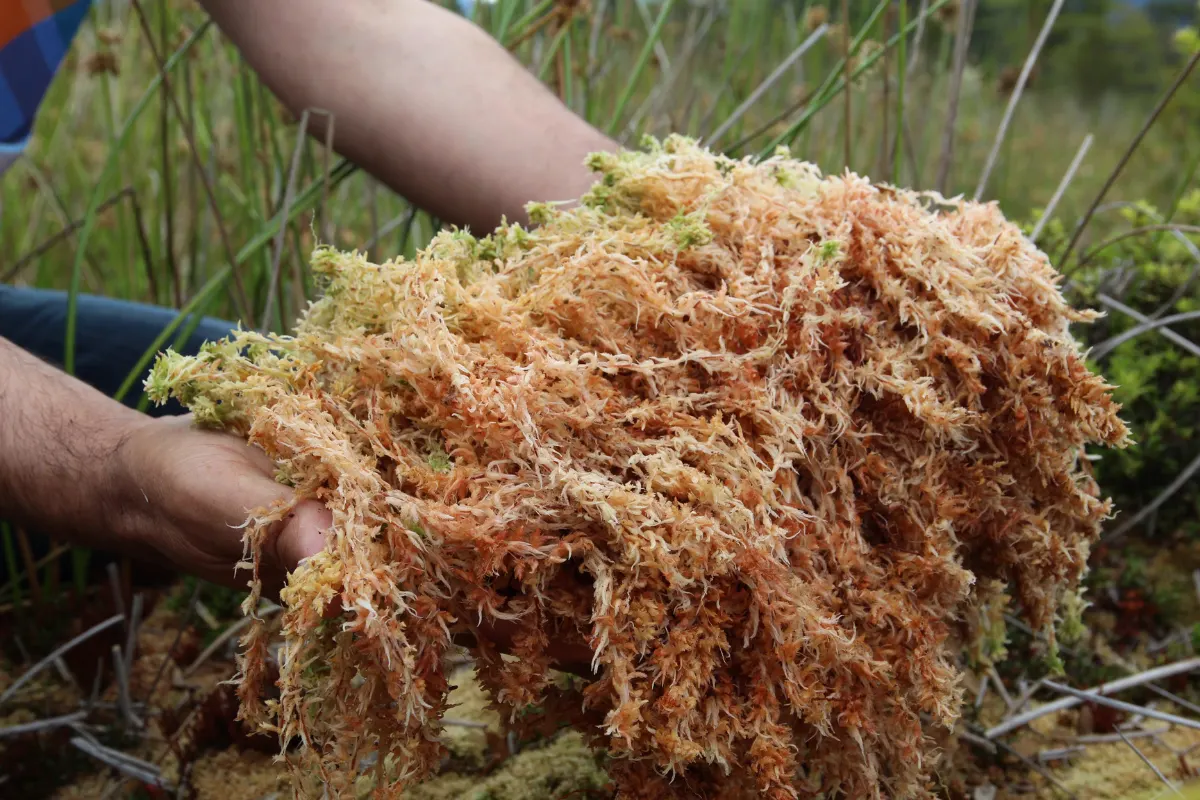
Most cosmetic-grade peat begins with sphagnum moss — a remarkable plant that engineers its own environment:
Sphagnum creates acidity. The moss actively exchanges cations (calcium, magnesium) from incoming water for hydrogen ions, acidifying its surroundings to pH 3.3–4.5. This acidity inhibits competing plants and decomposing bacteria.
Sphagnum holds water. Each sphagnum plant is mostly dead cells — large, empty hyaline cells that act as sponges, holding 20× the plant’s dry weight in water. This keeps the bog permanently waterlogged.
Sphagnum produces antimicrobials. The moss releases sphagnan (a polysaccharide), phenolic compounds, and tannins that suppress bacterial and fungal growth. This slows decomposition to a fraction of what occurs in normal soil.
The result: dead sphagnum doesn’t fully decompose. It accumulates, layer upon layer, century after century.
From Moss to Peat: Humification
As sphagnum layers are buried deeper, they undergo a slow transformation called humification:
- Fresh moss (surface) — Recognizable plant structures, low bioactive content
- Partial decomposition (0.5–2m depth) — Plant structures breaking down, humic substances beginning to form
- Well-humified peat (2m+ depth) — Original plant structure largely gone. Converted into a dark, paste-like material rich in humic acids, fulvic acids, and hymatomelanic acids
The degree of humification is measured on the von Post scale (H1–H10):
- H1–H3: Nearly undecomposed — recognizable plant structures
- H4–H6: Partially decomposed — some structure visible
- H7–H8: Well decomposed — paste-like, dark, high bioactive content
- H9–H10: Fully decomposed — amorphous, no visible plant structure
Cosmetic and therapeutic peat requires H6 or higher (ideally H8). This is where the concentration of bioactive humic substances is highest.
What Makes Peat Unique
Time
A peat layer 2 meters deep represents approximately 2,000–5,000 years of accumulation. The bioactive compounds in cosmetic peat are not manufactured — they are the product of millennia of slow biochemical transformation.
Complexity
Peat contains hundreds of distinct organic compounds — humic acids, fulvic acids, hymatomelanic acids, phenolic compounds, tannins, polysaccharides, lipids, waxes, organic acids, and trace minerals. No synthetic formulation replicates this complexity. Each compound class contributes different biological activities (anti-inflammatory, antioxidant, antimicrobial, chelating), and they work synergistically.
pH Compatibility
Peat’s natural pH (3.5–5.5) matches the skin’s acid mantle (4.5–5.5). Most cosmetic ingredients are formulated to be skin-compatible; peat already is.
Ecological Purity
The best therapeutic peat comes from the middle layers of raised (ombrotrophic) bogs — fed only by rainwater, not groundwater. These layers have the lowest contamination from atmospheric pollution, agricultural runoff, or bedrock minerals. Estonian research (Orru 2005) confirmed that all 34 trace elements tested in mid-layer bog peat were well below hazardous thresholds.
Types of Peatland
Raised bogs (ombrotrophic)
Fed by rainwater only. Acidic (pH 3.3–4.5), nutrient-poor, dominated by sphagnum moss. Low mineral content, high organic content. This is where the best cosmetic peat comes from — Estonian, Finnish, and Irish peat is predominantly from raised bogs.
Fens (minerotrophic)
Fed by groundwater and surface water. Less acidic (pH 4.5–7.0), nutrient-richer, dominated by sedges (Carex) and reeds. Higher mineral content. Central European therapeutic peat (German, Czech, Hungarian) often comes from fen-type peatlands, giving it different properties — more minerals, different humic acid profiles.
From Bog to Product
Cosmetic peat goes through several steps:
- Geological survey — Identify deposits with suitable humification (H6+), thickness (>0.7m), and below water table
- Chemical analysis — Measure humic acid, fulvic acid, trace elements, microbiological safety
- Extraction — Harvest from the suitable layer (not surface, not base)
- Processing — Fine grinding to smooth paste, possible extraction of specific fractions (FA, HA)
- Quality control — Verify bioactive content, check for contaminants, microbiological testing
- Formulation — Incorporate into product (mask, shampoo, cream, bath additive)