Bog Bodies — Peat's Extraordinary Preservation Power
Bog bodies are human remains preserved in peat bogs for hundreds or thousands of years — sometimes with skin, hair, nails, and internal organs intact. They are the most dramatic demonstration of peat’s antimicrobial and preservative properties, and they provide a visceral, unforgettable proof point for why peat works on living skin.
How Peat Preserves
The same properties that make peat therapeutically active also make it an extraordinary preservative:
- Acidity — Peat bogs are highly acidic (pH 3.3–4.5). This inhibits bacterial decomposition. The same pH compatibility that benefits living skin also prevents microbial breakdown of tissue after death.
- Anaerobic conditions — Waterlogged bogs lack oxygen, preventing aerobic decomposition. Tissues are essentially pickled in acidic, oxygen-free organic liquid.
- Humic acids — Bind to proteins and tan tissue in a process similar to leather tanning. Humic acid’s chelation of calcium removes it from bones (which is why bog body bones are often soft), but preserves soft tissue by cross-linking collagen fibers.
- Sphagnan — A polysaccharide from sphagnum moss that actively inhibits bacterial growth and binds nitrogen, starving decomposing microorganisms of essential nutrients.
- Antimicrobial phenolics — Tannins and phenolic compounds in peat directly suppress bacterial and fungal activity.
Famous Bog Bodies
Tollund Man (Denmark, ~400 BC)
Discovered in 1950 near Silkeborg, Jutland. Approximately 2,400 years old. Preserved so perfectly that discoverers initially believed it was a recent murder victim. His face, with closed eyes and faintly smiling expression, is one of the most iconic archaeological finds in history. Skin texture, stubble, and even the wrinkles on his forehead are visible. Found with a braided leather noose — believed to be a ritual sacrifice.
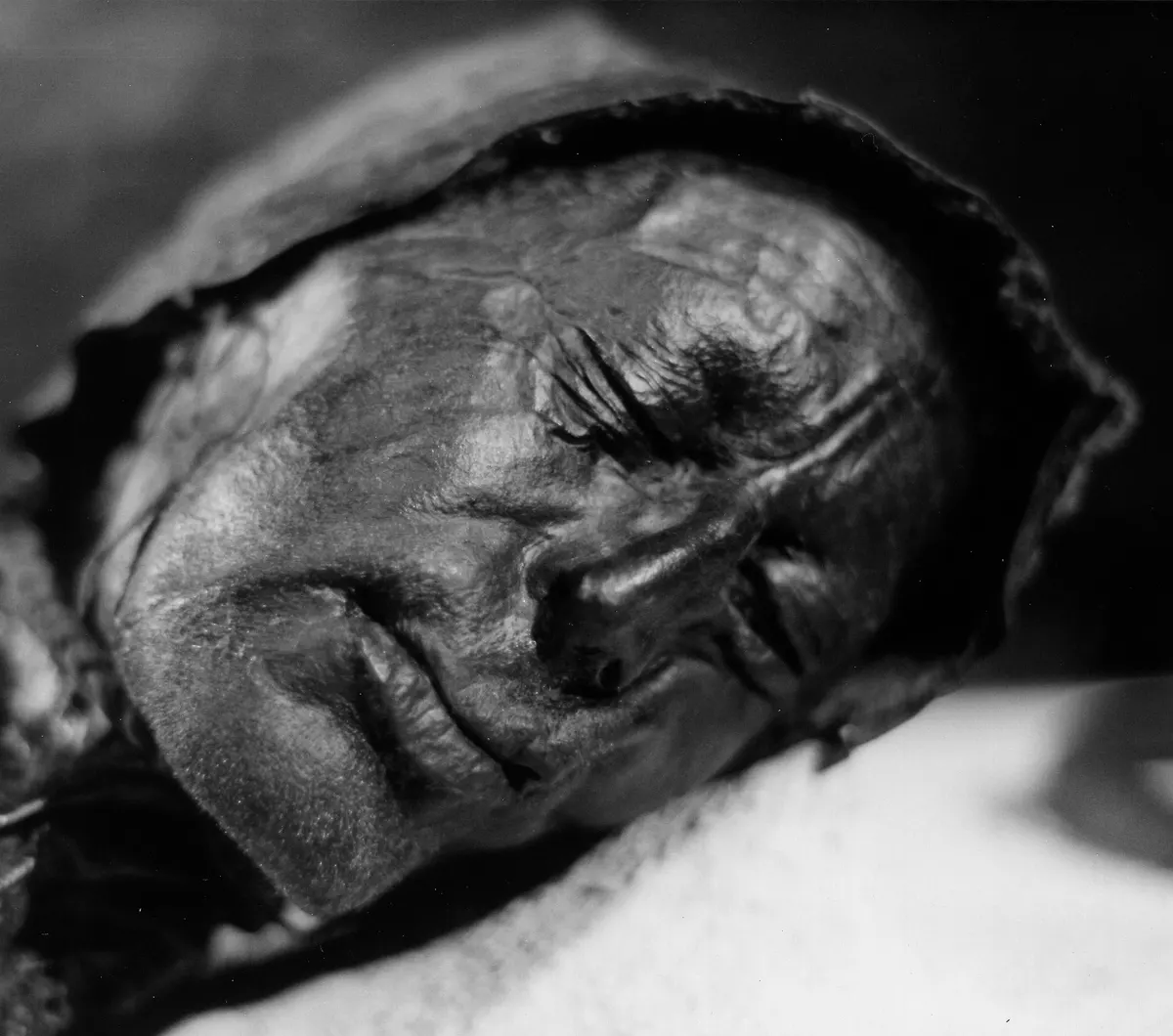 Photo: Sven Rosborn / Public Domain via Wikimedia Commons
Grauballe Man (Denmark, ~300 BC)
Discovered in 1952 near Grauballe, Jutland. Even more completely preserved than Tollund Man — his fingerprints are still readable. Hair is preserved (turned red by the bog acids — a common effect on dark hair). CT scanning revealed his last meal (porridge with seeds) and the cause of death (throat cut). His hands are so well preserved that detailed dermatoglyphic analysis was possible.
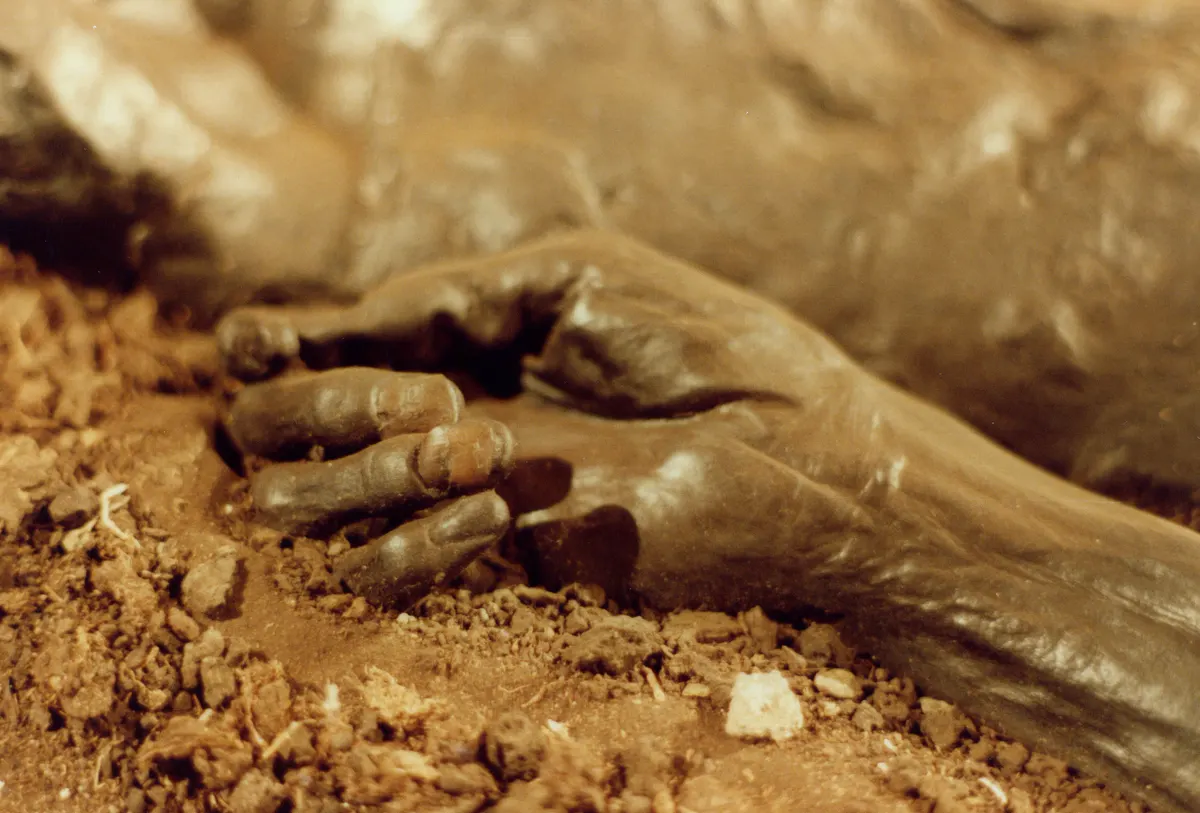 Photo: Sven Rosborn / Public Domain via Wikimedia Commons
Lindow Man (England, ~100 AD)
Discovered in 1984 at Lindow Moss, Cheshire. A 25-year-old man with trimmed beard and manicured nails — suggesting high social status. His skin and organs are preserved. Found to have been struck on the head, garroted, and had his throat cut — likely a triple ritual killing.
Clonycavan Man (Ireland, ~300 BC)
Discovered in 2003 in County Meath. Notable for having styled hair — held in place with an imported resin from France or Spain, suggesting international trade connections. His face and hair are remarkably preserved.
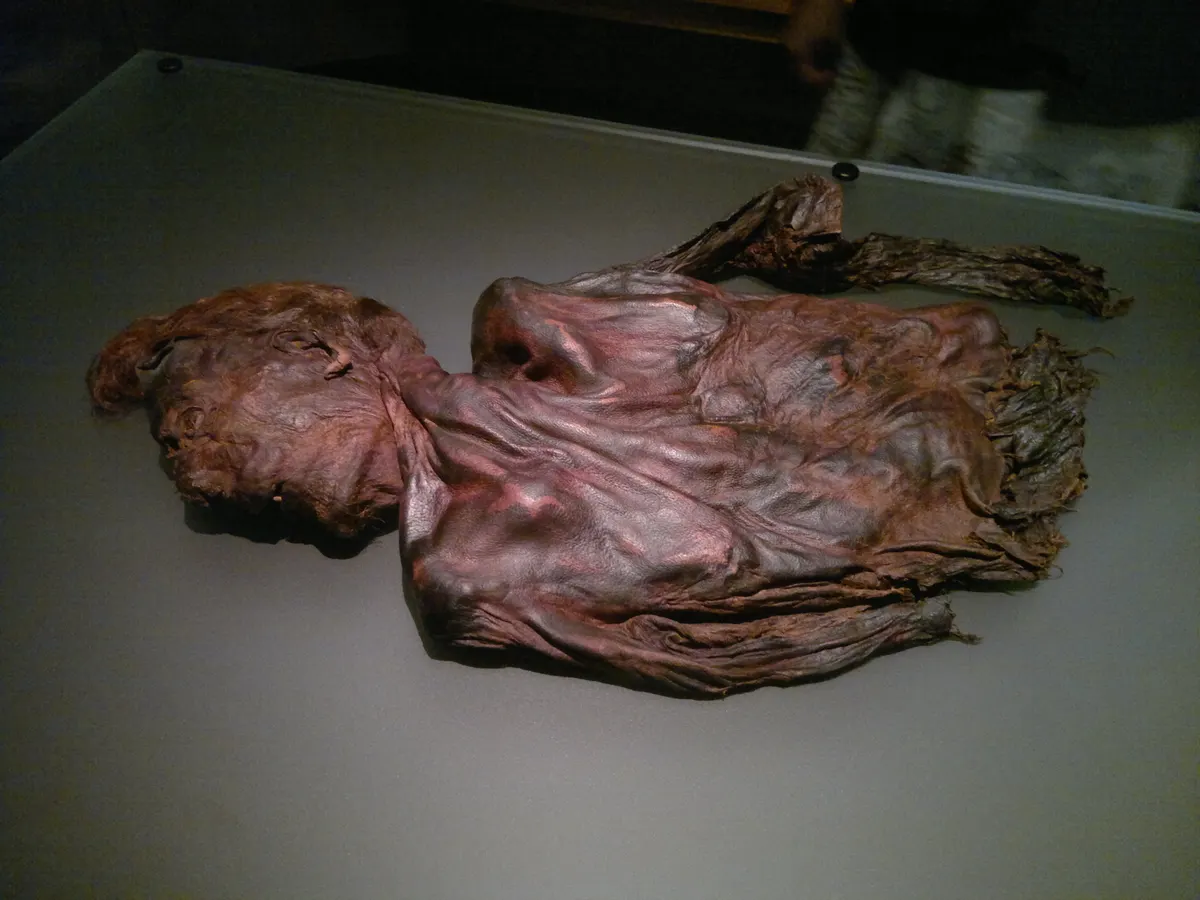 Photo: Mark Healey / CC BY-SA 2.0
Yde Girl (Netherlands, ~54 BC)
Discovered in 1897 near Yde, Drenthe. A teenage girl approximately 16 years old. Half of her face was preserved in extraordinary detail. Scientists created a forensic facial reconstruction that became famous.
Old Croghan Man (Ireland, ~362–175 BC)
Discovered in 2003 in County Offaly. Only the torso and arms survived, but the preservation quality is extraordinary — his pores, fingernails, and even the fine hairs on his arms are visible. Manicured nails suggest he did not do manual labor.
The Connection to Cosmetic Peat
Bog bodies demonstrate at scale what happens when peat acts on human skin:
-
Collagen preservation — Humic acids cross-link and stabilize collagen, the same protein that gives skin its structure. In living skin, this interaction may support collagen integrity and resist enzymatic breakdown.
-
Antimicrobial action — The same compounds that prevent 2,400-year-old tissue from decomposing also protect living skin from pathogenic microorganisms. This is not theoretical — it is demonstrated by millennia of preserved tissue.
-
Tanning and pH protection — The acid-tanning process that preserves bog body skin is a gentler version of what happens during a peat face mask or bath. Living skin is exposed to the same humic acid environment, at the same pH range, for a much shorter time — enough to benefit without the permanent effects.
-
Hair preservation — Bog bodies frequently retain hair (often turned red by peat acids). The preservation of hair shafts and follicle structures over millennia suggests that peat creates conditions favorable to hair structure integrity.
Why This Matters for the Institute
Bog bodies are not a curiosity — they are evidence. They prove that the compounds in peat interact with human tissue in specific, measurable ways. The same humic acids, tannins, and antimicrobial compounds that preserve a 2,400-year-old face are present in the peat mask you apply for 15 minutes. The difference is duration and concentration, not mechanism.
For the Cosmetic Peat Association, bog bodies are the ultimate credibility builder: nature already ran the experiment, at full scale, with human tissue, for thousands of years.
Notable Collections
- Silkeborg Museum (Denmark) — Tollund Man
- Moesgaard Museum (Denmark) — Grauballe Man
- British Museum (England) — Lindow Man
- National Museum of Ireland (Dublin) — Clonycavan Man, Old Croghan Man
- Drents Museum (Netherlands) — Yde Girl and others